Sunday, 19 June 2011


All File Hosting Premium Link Generators Updated June,2011

All File Hosting Premium Link Generators Updated June,2011
Enjoy.......
Hotfile
Megaupload
Filesonic
Fileserve
Netload
Gigasize
Uploded.to
Depositfiles
Rapidshare
Mediafire
Frekshare
Badango
2shared
Shareflare
Divshare
Bitshare
Uplaoding
Filefactory
Turbobit
Sharecash
Filesend
Zshare
Vipfile, Etc
http://www.wupload.com/file/17046854/Premium_Link_Generator.rar
India To Reach 100 Million Mobile Money Subscribers by 2015
According to Tavess Research mobile money in emerging markets of Middle East, Asia, and Africa, is expected to cross 1 billion users by 2015 with India accounting for over 100 million subscribers.
Enabling purchases and transfers using mobile devices as wallet, mobile money has become an imperative service particularly in areas with high mobile penetration and limited banking facilities.
In these areas, operators are laying strong emphasis on providing enhanced mobile banking services that are increasingly being adopted by consumers who are looking for secure and convenient banking and bill payment options.
Although in nascent stages, the 790 million mobile subscriber base and the huge unbanked rural population makes India a very attractive destination for this service. Initiatives, such as Reserve Bank of India’s (RBI) easing of stringent regulations pertaining to mobile banking via increase of cap on fund transfers from INR 5,000 to INR 50,000; and new interbank mobile payment service launched by the National Payment Corporation of India (NPCI), are nurturing the required ecosystem for increased roll-out and adoption of mobile money.
NPCI is currently receiving a lukewarm response with 10 million users registered for interbank mobile payment service recording transactions worth only INR1.5 crore ($.33 million) in April 2011. However, Tavess expects greater adoption of mobile money in the near future with service providers launching customer education campaigns and easy to use functionalities – taking the total subscriber base to 100 million by 2015.
The mobile money service mChek has seen the maximum uptake in the Indian market with two million subscribers followed by NG Pay with one million and others (such as , Airtel Money, PayMate and Mobile Money Services – Nokia’s initiative along with Yes bank).
Lack of well developed regulatory frameworks, maintenance of cash floats, and lack of technical know-how continues to be the key challenges in mobile money service adoption
Despite the success of mobile money service in emerging markets, its adoption is still not widespread due to various challenges pertaining to lack of a well developed regulatory framework for mobile payments, maintenance of cash floats by agents residing in rural and semi rural areas (who are required to make regular trips to far away banks for maintaining cash floats), lack of technical know-how among users, and mandate by a few mobile payment services for subscribers to have bank accounts – making mobile money a challenging proposition for the unbanked rural population.
The key focus area for mobile operators targeting the mobile money market includes service customization to cater to the local population and localization of the go-to market strategies.. In addition, right pricing of the mobile banking service to provide affordable services to the subscribers while not compromising on the agent’s commission involved, is key to making the service attractive for both the subscribers and the agents.
Tavess believes that strong focus on localized mobile banking services provided at an affordable price will be the step in the right direction for the service providers to increase their current ARPU levels in this burgeoning mobile money market.
Saturday, 16 April 2011
Dell Streak 7 Review

Even though they’re still trying to secure carrier partnerships for their products, Dell is no stranger in the Android space especially when it caught us by surprise with the original Dell Streak. Luckily for them, they were able to snag T-Mobile’s attention and get their latest venture, the Dell Streak 7, onto the lineup of the nation’s number four wireless carrier. When so many Android tablets require such a high premium cost of ownership, it’s utterly refreshing to see that the Dell Streak 7 is priced at $200 with a contract, and more importantly, it’s under the $500 threshold at $449.99 no-contract. Sharing some similarities with its 5” sibling, the Dell Streak 7 is fully committing itself into the tablet realm, but does it stand a chance against the competition?
 |  |
- Dell Streak 7
- USB cable
- Hands-free Headset
- Wall Charger
- Quick Start Guide
Instantly, we’re quickly reminded on how the Dell Streak 7 closely mimics the design of its slightly smaller 5” variant with its sloped sides, however, it decides to employ this tough plastic shell instead. Still tallying in at a manageable 0.49” thickness, we’re happy with the overall size of the tablet, which is quite comfortable to hold with even one hand, but there is a surprising amount of weight with this one. Furthermore, its screen is definitely a magnet for smudges and finger prints, but its plastic casing combined with its criss-cross pattern manages to handle well in keeping everything else looking clean. Taking most of its design cues from the original Dell Streak 5, we still find the implementation to work well with this one – especially for something regarded as a full figured tablet.
Taking advantage of its speedy HSPA+ connection, we find a 1.3-megapixel front facing camera for video chat and shooting self-portraits perched above its display, while the usual set of Android capacitive buttons are located on the right along the sloped side. Happily, the three buttons are finger friendly in size and we didn’t have any trouble pressing them; nor did we run into any problems accidentally hitting them.
Meanwhile, the rigid feeling volume rocker and dedicated power button are sitting close-by next to one another on the top edge, and in fact, they exhibit a sensible response when pressed. If it were a smartphone, we would be appalled to find a proprietary charging/data connection port, but since this is a tablet we’re talking about, the one on the Dell Streak 7 doesn’t come as a surprise.
Dell Streak 7 Review
Share this page:
Compared to other relatively fresh Android tablets on the market, like the Motorola XOOM, some would assume that the Dell Streak 7 is diminutive in the processing category. However, you’ll be somewhat astonished to find a contemporary 1GHz dual-core NVIDIA Tegra 2 processor at the heart of this device. Somewhat uncharacteristic of such a high caliber chipset, we find some less than appealing choppiness going on when navigating across its homescreens – and even more when a live wallpaper is activated. However, it’s not to the point unwieldy, but we would like to see more fluid movements with its operation.
Dell didn’t do anything extraordinary with the Android 2.2 Froyo experience on this one, but it utilized its Stage user interface that we view as favorable thanks to its useful set of homescreen sized widgets. Of course, there are some enhancements to it over the stock experience, but considering that this is a much more powerful machine than the original, it would’ve been nice to see even a subtle customization. By now, Honeycomb is indeed the preferred choice for new tablets, but regardless, the overall experience with the Dell Streak 7 is still pretty satisfactory.
Camera and Multimedia:
If you’re still planning to carry the Dell Streak 7 in your back pocket, there’s no denying the allure that goes behind taking candid shots with it – even for tablet! Unfortunately, we’re not all too thrilled by the so-so quality produced by its 5-megaixel auto-focus camera. After capturing some images, it produces some muddy looking backgrounds with slightly acceptable details with foreground images. Moreover, its cooler looking color output generally applies this ethereal effect which tends to make shots seem over-exposed.
Novatel MiFi 3G/4G 4082 for Sprint Review
Introduction and Design:
The Novatel MiFi 2220 was a groundbreaking device when it launched, but it has been nearly two years since the 3G mobile hotspot device first hit the market. Since then Sierra has stolen most of the market with their 4G capable Overdrive mobile hotspot. Well Novatel is back with the MiFi 3G/4G 4082, adding WiMax and support for a memory card. Included with the MiFi 3G/4G you’ll get a microUSB cable, AC adapter, slip pouch and a beefed up 1530mAh battery.
We always liked the looks of the original MiFi 2200; it was a slim, sleek device and looked equally good in Sprint silver and Verizon black. This time around the MiFi is black with chrome accents (the Verizon 4G variant shares a color scheme) and looks very sharp. The MiFi 3G/4G is considerably thicker thanks to the 1530mAh battery, a considerable jump from the 1150mAh one found in the 2200.
Another key difference is the addition of a small LCD screen, with a concave chrome power button below. The function is very basic, letting you know your signal and battery strength, GPS status and how many devices are connected to the MiFi. There is an LED on the bottom of the MiFi 3G/4G that indicates which network you are using: green for 3G, blue for 4G or orange if you don’t have service.
Also along the bottom is the microSD slot, microUSB charging port and a WPS button to enable security. We appreciate the addition of the microSD slot. By inserting a card (it supports up to 32GB) you enable network storage between any of the up to five connected devices on the MiFi 3G/4G. This isn’t a new feature (we saw it on the Overdrive) but it is a nice addition nonetheless.
Performance and Conclusion:
Performance on Sprint’s 4G WiMax network was on par with our past experiences. In our testing it averaged just over 7mbps down and just under 1mbps up with an average ping of 129ms. These results are slightly better overall than we got with the Sierra U250 when we did our 4G comparison. Novatel claims that you can get 4 hours of usage with the MiFi 3G/4G thanks to the larger battery, but heavy users will probably want to pack the charger or pick up an extra battery.
 |
We always liked the looks of the original MiFi 2200; it was a slim, sleek device and looked equally good in Sprint silver and Verizon black. This time around the MiFi is black with chrome accents (the Verizon 4G variant shares a color scheme) and looks very sharp. The MiFi 3G/4G is considerably thicker thanks to the 1530mAh battery, a considerable jump from the 1150mAh one found in the 2200.
 |  |  |
The Novatel MiFi 3G/4G 4082 is black with chrome accents | ||
Another key difference is the addition of a small LCD screen, with a concave chrome power button below. The function is very basic, letting you know your signal and battery strength, GPS status and how many devices are connected to the MiFi. There is an LED on the bottom of the MiFi 3G/4G that indicates which network you are using: green for 3G, blue for 4G or orange if you don’t have service.
 |  |  |
The Novatel MiFi 3G/4G 4082 (L) next to the Novatel MiFi 2220 (R) | ||
Also along the bottom is the microSD slot, microUSB charging port and a WPS button to enable security. We appreciate the addition of the microSD slot. By inserting a card (it supports up to 32GB) you enable network storage between any of the up to five connected devices on the MiFi 3G/4G. This isn’t a new feature (we saw it on the Overdrive) but it is a nice addition nonetheless.
Performance and Conclusion:
Pros
- 4G connectivity
- microSD slot for network storage
Cons
- LCD has limited functionality
- Battery could be better
- It was already outdone by the competition before it launched
Friday, 15 April 2011
DOT Ban’s Nokia’s Pushmail Service Over Security Concerns

This ban comes at a time when Blackberry services are under the government’s scanner due to the security related issue for not providing a solution to intercept its Enterprise mail services.
TOI reports nearly 50 per cent of Nokia’s E Series business phones sold in the country get activated for e-mails.These developments came at a time when the home ministry has asked the telecom and IT departments to overhaul existing legal frameworks to broaden the meaning of telecom/internet services.
At present Nokia’s pushmail service supports major email service providers like Hotmail Yahoo and Gmail and various other leading email service providers.
TOI also reports IT ministry have been asked by the home ministry to make necessary changes in Indian Telegraph Act of 1885, the Information Technology (Amendment) Act, 2007.
Once the changes comes into place it will be necessary for all telecom service providers to have the systems in place to deliver authorised intercepts based on telephone numbers, device identity, email IDs, IP addresses or keywords to the national security agencies on real-time basis.
Wednesday, 13 April 2011
Kapil Sibal Issues Progress Report on The 100 Days Plan of Action
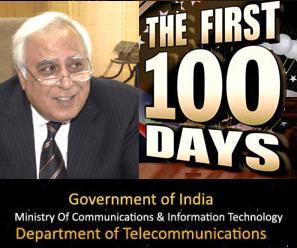
The 100 Day Action Plan was announced in Jan 2011 on various issues such as MNP, Wireless Broadband, 2G Spectrum Allocation, MTNL/BSNL and other PSUs, Mobile Tower Radiation and National Telecom Policy 2011 as earlier we shared on TelecomTalk.
The Point-wise Report Card on Plan of Action for DoT announced by Telecom Minister, as follows :
Action Point 1 : We will hold consultations with key stakeholders to evolve a clear and transparent regime covering licensing, spectrum allocation, tariffs/pricing, linkage with roll out performance, flexibility within licenses, spectrum sharing, spectrum trading, MVNOs, unlicensed bands, M&A, etc. in a technology agnostic environment after due consideration of TRAI recommendations in this regard. Interest of the ‘Aam Aadmi’ would be the prime consideration.
Status : The Department of Telecommunications (DoT) received Telecom Regulatory Authority of India (TRAI) recommendations dated 8.2.2011 on spectrum pricing in continuation of the earlier TRAI recommendations dated 11.05.2010 on spectrum management and licensing framework. A Round Table Conference was held on 8.3.2011 by the Minister of Communications & IT with the key stakeholders on issues of licensing and spectrum. After the Round Table Conference, the verbatim of the discussions held was posted on website of DoT. The views expressed by the stakeholders during the Round Table Conference are being examined in DoT by the Internal Committee under the Chairmanship of Member (Technical) of the Telecom Commission.
Action Point 2 : To ensure availability of spectrum for telecom industry, we will initiate a dialogue with Department of Space/Information & Broadcasting/Defence, PSUs on vacation of spectrum and for identification of Defence Band and Defence Interest Zone. National Frequency Allocation Plan 2011 (NFAP) shall be released. Spectrum allocations, availability and status of pending applications for spectrum shall be published on the department’s web site.
Status : NA.
Action Point 3 : Immediate steps will be taken to resolve outstanding security issues. Steps will be taken to enable operators to launch 3G services in their entire plenitude without delay. Security issues regarding telecom equipment procurement, messenger services and subscriber verification will be resolved. Steps will be taken to establish the Central Monitoring System which will facilitate and prevent misuse of lawful interception facility.
Status : 3G Service launched by operators.
Action Point 4 : 11 years have passed since NTP ’99 and many changes have taken place thereafter. Action will be initiated to formulate a comprehensive Telecom Policy 2011 including the recognition of Telecom as infrastructure and as an essential service, encouraging Green Telecom, steps to accelerate migration from IPv4 to IPv6 at the earliest, release of IPv6 standards by Telecom Engineering Centre for implementation in the country, etc.
Status : DoT has already initiated the process to formulate a comprehensive National Telecom Policy (NTP) 2011. This will take into account the changes that have taken place in the industry since NTP 1999. A Committee has been constituted with Additional Secretary (T) and Advisor (T) as the co-chairman and DDGs as Members. Two rounds of the meetings have already taken place since then and eight teams have been constituted to work on specific areas.
Action Point 5 : All possible efforts will be made to fill up Board Level vacancies in PSUs and for greater participation of BSNL/ MTNL and C-DOT in national and socially important programmes, while addressing structural issues, improving internal efficiency and financial performance of BSNL/ MTNL.
Status : Close monitoring and follow up is being done to ensure filling up of board level vacancies in PSUs. Filling up the post of CMDs of BSNL and MTNL has been taken up on priority basis and will be finalised shortly. The post of Director (HR), BSNL and Director (F), ITI have been filled up. The proposal for non-official Directors in BSNL/MTNL/ITI/TCIL have also been drawn up. Both BSNL/MTNL have been given roadmap for improving their internal efficiency.The proposal of Director (F), TCIL and Director (HR), ITI are also in advanced stage.
Action Point 6 : Country-wide launch of Mobile Number Portability (MNP).
Status : The Prime Minister of India launched MNP on Pan India basis on January 20, 2011 in Delhi.
Action Point 7 : Vigorous measures will be taken to address public concerns about health hazards due to the EMF radiation from Mobile towers including laying down relevant standards, supplementing equipment with Telecom Enforcement, Resource and Monitoring (TERM) Cells and ensuring adequate field-testing.
Status :The report of the Inter-Ministerial Group on EMF radiations has been put up on the website of the Ministry for seeking comments. Feedback has been received which is being examined and will be finalised shortly.
Action Pint 8 : Formulation of a package of measures to promote manufacturing of telecom equipment in the country.
Status : TRAI has circulated a consultation paper on promotion of manufacturing of Telecom equipment in the country. After receiving the recommendations of TRAI in this respect, DoT will organise Round Table Conference with key stakeholders to formulate the package of measures for promoting manufacturing of Telecom Equipment. Sectoral Innovation Council has been set up under the Chairmanship of ED, C-DOT with participation from the Industry representatives to give impetus to innovations and R&D in telecom sector within the country.Certain initiatives taken by Department of Information Technology (DIT) in this regard are as follows:
Action Point 9 : Launch of a Wireless Broadband Scheme scheme by USOF to provide wireless broadband coverage to about 5 lakh villages, leveraging the existing passive infrastructure created for mobile telephony in rural and remote areas.
Status : The wireless broadband scheme for providing wireless broadband coverage to about five lakh villages leveraging the existing PSUs infrastructure has already been approved and will be launched shortly.
Action point 10 Concrete steps towards finalization of National Broadband Plan including strategy for implementation and initiation of steps for roll out of Optical Fibre
Status : After receiving the recommendation of TRAI on National Broadband Plan on 08.12.2011 as well as the report of the CII on broadband, the Round Table Conference was held by Hon’ble MOC&IT on 19.01.2011. Thereafter a scheme for creation of National Optical Fibre Network (NOFN) for providing broadband connectivity to the panchayats by extending the existing optical fibre network to panchayats utilising the USO fund has been formulated.
This proposed scheme has also been deliberated by Hon’ble MOC&IT along with Shri Sam Pitroda, Adviser to PM on Public Information, Innovation and Infrastructure, on 30.03.2011 with key stakeholders including telecom service providers. Under this scheme it is proposed to set up a High Level Committee to steer and coordinate all the activities related to the creation and implementation of NOFN.
Subscribe to:
Posts (Atom)